The Battlefield

Blasphemous Act
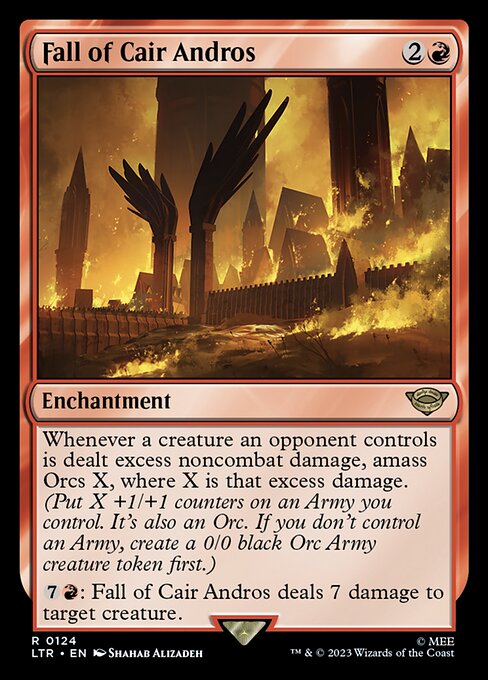
Fall of Cair Andros
AI DraftSep 5, 2026

Blasphemous Act + Fall of Cair Andros

AI draft — not yet human-reviewed. Check citations and flag anything that looks wrong. How pages are reviewed.

Overview
When Blasphemous Act resolves it deals 13 noncombat damage to each creature and that damage is marked on those creatures . For each opponent creature dealt damage by Blasphemous Act, Fall of Cair Andros will trigger if there is any excess noncombat damage; each trigger’s X equals the excess damage. Those triggers are put on the stack after damage is dealt and state-based actions are checked . When each Fall trigger resolves you amass Orcs X: if you already control an Army creature you put X +1/+1 counters on it; if you don’t, you create a 0/0 black Orc Army token and then put the counters on it . Whether an Army has “summoning sickness” is determined by whether that specific Army creature has been under its controller’s control continuously since the beginning of that player’s most recent turn ; adding +1/+1 counters from amass does not remove summoning sickness. If the Army existed before Blasphemous Act finished resolving it keeps whatever summoning-sickness status it already had; any Army created by amass that enters during resolution will have summoning sickness until it has been under its controller’s control since the start of that controller’s turn .
Step 1
Cast Blasphemous Act. Its cost is calculated and paid as part of casting — players can respond after it’s cast but not before the cost calculation and payment .
Step 2
Blasphemous Act resolves and deals 13 damage to each creature. That damage is noncombat damage and is marked on each creature dealt damage .
Step 3
As damage is dealt, Fall of Cair Andros will notice damage being dealt to creatures your opponents control. For each creature where some of that damage is excess noncombat damage, Fall creates a triggered ability with X equal to that excess; those triggers are placed on the stack after state-based actions are checked .
Step 4
State-based actions see creatures whose marked damage is greater than or equal to their toughness and destroy them as appropriate ; note that whether a Fall trigger exists depends on the damage event (the trigger checks the damage event), not on whether the creature later survives.
Step 5
Players receive priority with the newly created Fall triggers on the stack. Opponents may respond to those triggers before they resolve .
Step 6
Each Fall trigger, when it resolves, instructs you to amass Orcs X. If you control an Army creature at that moment, you choose an Army you control and put X +1/+1 counters on it. If you don’t control an Army creature at that moment, you first create a 0/0 black Orc Army creature token, then choose an Army (the new token) and put X +1/+1 counters on it. That sequence is dictated by the amass ruling .
Step 7
If an Army that already existed on the battlefield before Blasphemous Act resolved receives +1/+1 counters from amass, those counters do not remove or alter summoning sickness. Its ability to attack or use abilities with tap/untap symbols remains determined by whether it has been under its controller’s control continuously since the beginning of that controller’s most recent turn .
Step 8
Any Army token created by amass enters the battlefield when the trigger resolves; because it just entered, it hasn’t been under its controller’s control since the beginning of that player’s most recent turn, so it will have summoning sickness until the appropriate start-of-turn condition is met .
Resolution
Blasphemous Act deals 13 damage to each creature and damage is marked on them . For each opponent creature where some of that damage is in excess of what was needed to be lethal, Fall of Cair Andros triggers with X equal to that excess; those triggers go on the stack after damage is dealt and state-based actions are checked . When a Fall trigger resolves, amass Orcs X: if you control an Army already, put X +1/+1 counters on that Army; if you don’t, create a 0/0 black Orc Army token and then put X +1/+1 counters on it . An Army that was already on the battlefield before Blasphemous Act resolved keeps its existing summoning-sickness status; adding counters from amass does not remove summoning sickness. Any Army token created by amass enters the battlefield at the moment that trigger resolves and therefore will have summoning sickness until it has been under its controller’s control since the beginning of that controller’s most recent turn .
Feedback