The Battlefield

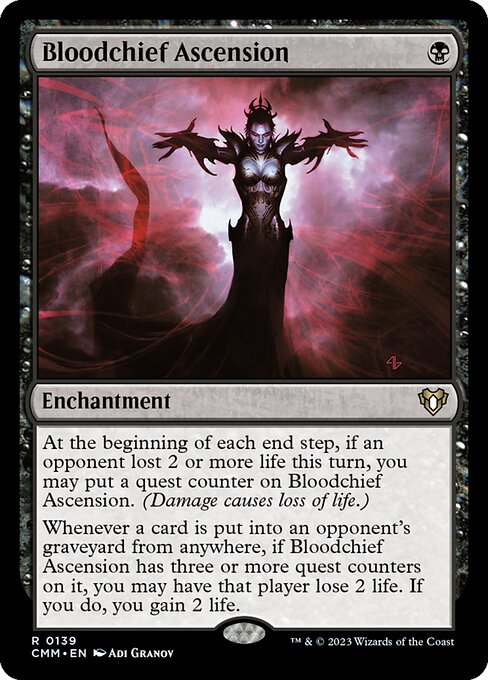
Bloodchief Ascension
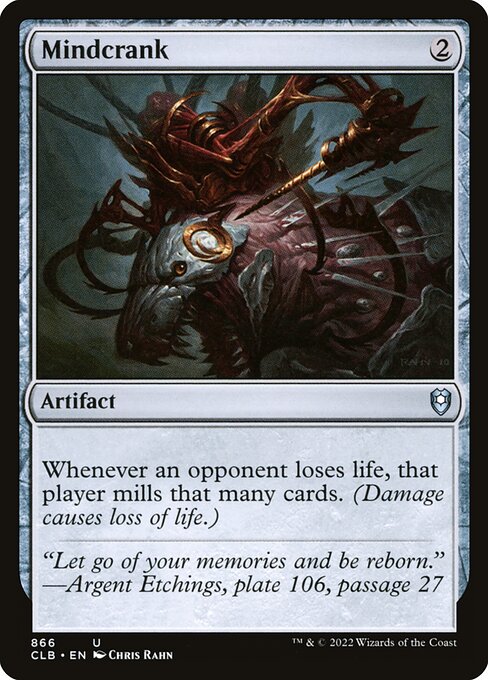
Mindcrank
AI DraftFeb 26, 2026

Bloodchief Ascension + Mindcrank

Overview
If Bloodchief Ascension has three or more quest counters, each time a card is put into an opponent’s graveyard it will trigger its second ability (the intervening-"if" must be true when the card is put into the graveyard) and, when that triggered ability resolves, you may have that player lose 2 life and you gain 2 life; that loss of life will trigger Mindcrank, which mills that player for 2, and each milled card put into the graveyard will itself trigger Bloodchief Ascension again (if it still has three or more quest counters), producing a repeating chain unless stopped. The intervening-"if" on Bloodchief’s first ability means it only gets quest counters if an opponent had already lost 2+ life by the time the end step begins [Ruling 2009-10-01].
Step 1
Prerequisite: Bloodchief Ascension has three or more quest counters (the "if" in its second ability will be true) and you control Mindcrank.
Step 2
An event puts a card into an opponent’s graveyard from anywhere (example: they mill a card, discard a card, a creature they control dies). That event meets the trigger condition "Whenever a card is put into an opponent's graveyard from anywhere..." on Bloodchief Ascension and — because Bloodchief currently has three or more quest counters — the intervening-"if" is true, so a Bloodchief Ascension triggered ability is created and goes on the stack [Ruling 2009-10-01].
Step 3
When that Bloodchief trigger resolves, you are presented with the optional action phrased as "you may have that player lose 2 life." That optional action is chosen (or declined) as the triggered ability resolves; choosing to have them lose 2 life is effectively paid when the ability resolves per .
Step 4
If you choose to have the player lose 2 life, that life loss occurs as part of the Bloodchief ability’s resolution; after the life loss occurs the ability then causes you to gain 2 life (the "If you do, you gain 2 life" part checks that you chose to have them lose life) .
Step 5
When the opponent loses 2 life, Mindcrank’s triggered ability(s) trigger because Mindcrank reads "Whenever an opponent loses life, that player mills that many cards." For the 2 life lost, Mindcrank will trigger and, when that trigger resolves, that opponent will mill 2 cards (i.e., put up to two cards from the top of their library into their graveyard).
Step 6
Each card that is put into the opponent’s graveyard by Mindcrank’s milling is a "card put into an opponent’s graveyard from anywhere," so each such card will cause Bloodchief Ascension’s "Whenever a card is put into an opponent's graveyard..." ability to trigger again (the intervening-"if" is checked at the time of the card-entering event; if Bloodchief still has three or more counters it will trigger again) [Ruling 2009-10-01].
Step 7
Those new Bloodchief triggers go on the stack; when they resolve you again choose whether to have the opponent lose 2 life (the choice is made on resolution per ). If you choose yes, each such resolution causes further life loss, which in turn triggers Mindcrank again, milling more cards and potentially creating more Bloodchief triggers, and so on.
Step 8
The loop proceeds as a series of discrete triggered abilities on the stack resolving one at a time. The loop stops when you decline Bloodchief’s "may" (so no life loss happens and Mindcrank does not trigger), Bloodchief loses its three-or-more-counters state, Mindcrank or Bloodchief are removed, a replacement or prevention effect prevents the life loss or the mill, the opponent has no cards left to mill (and other game consequences follow), or the game otherwise changes state to stop the chain.
Resolution
With Bloodchief Ascension at three or more quest counters and you controlling Mindcrank, Bloodchief’s "Whenever a card is put into an opponent's graveyard from anywhere, if this enchantment has three or more quest counters on it, you may have that player lose 2 life. If you do, you gain 2 life." triggers for each card put into the opponent’s graveyard; when each such Bloodchief trigger resolves you may choose to make the opponent lose 2 life (that choice is made on resolution — see ); if you do, Mindcrank will trigger from that loss and cause the opponent to mill 2, which will put up to two cards into the graveyard and thereby create up to two more Bloodchief triggers (assuming the intervening-"if" is still true). This can loop until someone stops choosing the "may" or until other game-state constraints (empty library, replacement effects, preventing life loss, removal of Bloodchief/Mindcrank, or the enchantment losing its counters) stop it. See the step-by-step sequence below and the cited rules and [Ruling 2009-10-01].
Feedback