The Battlefield

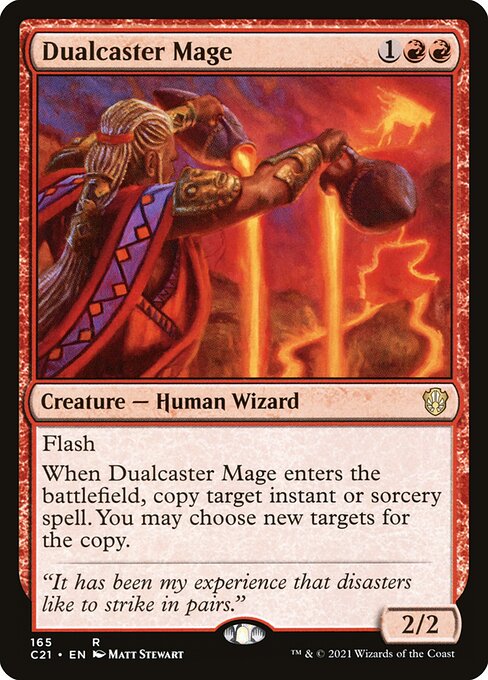
Dualcaster Mage
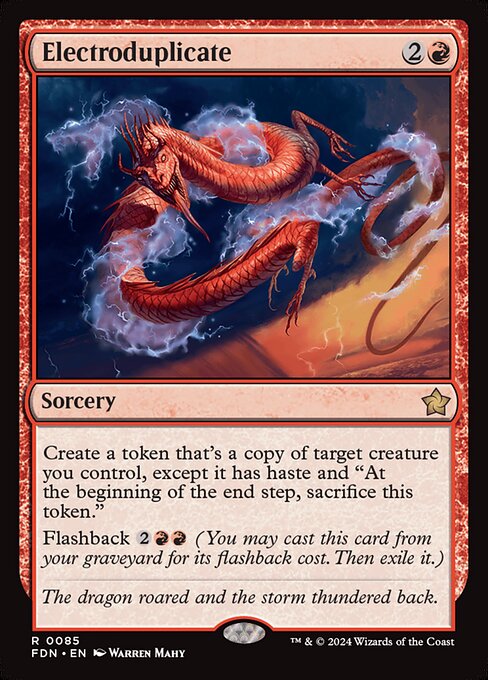
Electroduplicate
AI DraftFeb 26, 2026

Dualcaster Mage + Electroduplicate

Overview
If Electroduplicate is a sorcery spell on the stack and Dualcaster Mage enters the battlefield in response, Dualcaster Mage’s triggered ability can target that Electroduplicate spell and put a copy of that spell onto the stack that is controlled by the Mage’s controller; that copy can target a creature that Mage’s controller controls (you may choose new targets for the copy) and, when the copy resolves, it will create the token for that controller . The copy is a spell on the stack (not a card), so it isn’t cast and isn’t itself subject to being exiled by Electroduplicate’s flashback rule; if the original Electroduplicate was cast using flashback, the original card (the card on which flashback was paid) will be exiled as specified when it would leave the stack .
Step 1
An opponent (or you) has Electroduplicate on the stack as a sorcery spell that was cast (possibly from hand or from graveyard using flashback). See casting rules for how that spell was put on the stack .
Step 2
You cast Dualcaster Mage (it has flash, so you cast it any time you could cast an instant) in response to Electroduplicate or otherwise cause it to enter the battlefield while Electroduplicate is on the stack .
Step 3
When Dualcaster Mage enters the battlefield its triggered ability triggers: “When this creature enters, copy target instant or sorcery spell. You may choose new targets for the copy.” That trigger goes on the stack and later resolves, targeting the Electroduplicate spell on the stack (the trigger can target any instant or sorcery spell on the stack) [706.10; Ruling 2016-06-08].
Step 4
When the trigger resolves it puts a copy of the targeted Electroduplicate spell onto the stack. That copy is a spell on the stack, not a card, and it is owned and controlled by the player who controlled Dualcaster Mage when the trigger resolved .
Step 5
As part of creating the copy, the Mage’s controller may choose new targets for that copy (the controller may leave targets unchanged even if they’re now illegal, or change them but any new targets must be legal) .
Step 6
The copy resolves like a normal Electroduplicate spell. When it resolves it creates a token that’s a copy of the targeted creature you control, except it has haste and the delayed-sacrifice condition specified by the card; the token enters under the controller of the copy (the Mage’s controller) .
Step 7
If the original Electroduplicate was cast using flashback, the original card’s flashback replacement (exile it if flashback cost was paid) applies to that original card when it would leave the stack; the copy is not a card and is not affected by that replacement effect .
Resolution
If Electroduplicate is on the stack when Dualcaster Mage’s enter-the-battlefield trigger resolves, that trigger can copy the Electroduplicate spell and put a copy onto the stack that the Mage’s controller controls; that copy can have its targets changed by the Mage’s controller and will create the token for that controller when it resolves . The copy is a spell, not a card, so flashback’s exile-replacement (if the original was cast for flashback) applies only to the original card, not to the copy .
Feedback