The Battlefield

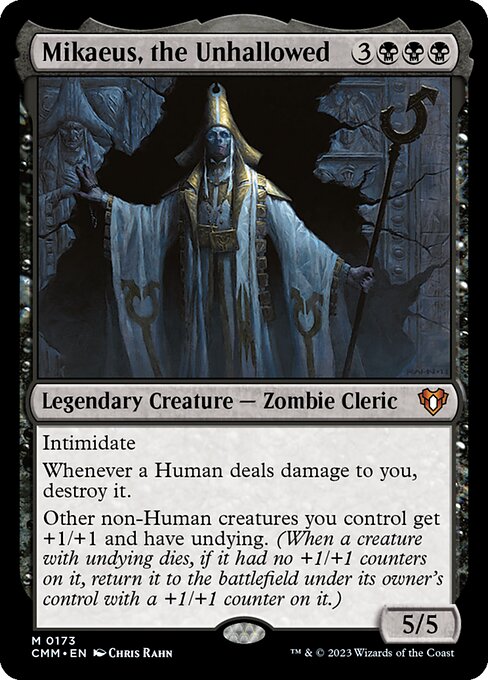
Mikaeus, the Unhallowed
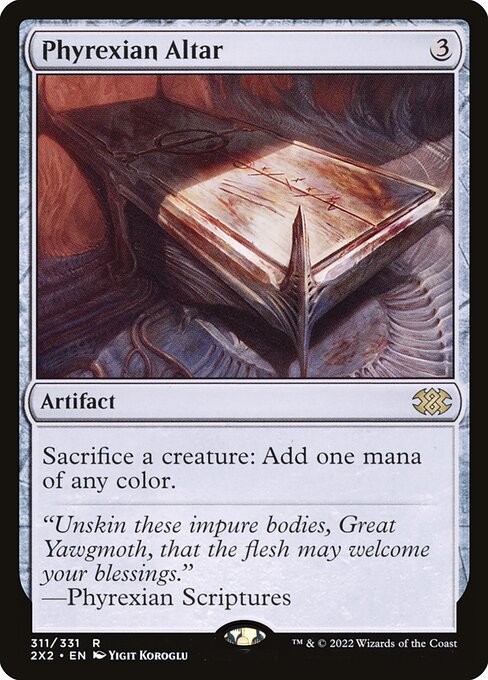
Phyrexian Altar
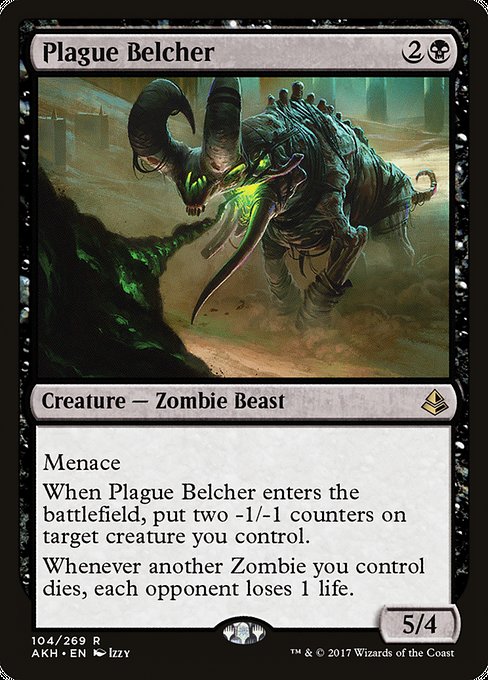
Plague Belcher
AI DraftFeb 26, 2026

Mikaeus, the Unhallowed + Phyrexian Altar + Plague Belcher

Overview
Mikaeus gives all your non-Human creatures +1/+1 (as a continuous effect) and undying; Plague Belcher ETB puts two -1/-1 counters on a target creature you control and triggers when another Zombie you control dies; Phyrexian Altar lets you sacrifice creatures for mana. Key results: sacrificing a non-Human Zombie to Phyrexian Altar will cause Plague Belcher to trigger (each opponent loses 1 life) and—if the sacrificed creature had no +1/+1 counters—Mikaeus’s undying will trigger to return it to the battlefield with a +1/+1 counter . Counter interactions (both +1/+1 and -1/-1) are removed per , and state-based actions will put creatures with toughness 0 or less into the graveyard as appropriate [704.5f/704.5g]. If multiple Zombies die simultaneously, Plague Belcher will trigger for each other Zombie that died [Ruling 2017-04-18]; if Mikaeus dies at the same time as a non-Human, undying granted by Mikaeus still triggers for that creature if it had no +1/+1 counters when it died [Ruling 2018-12-07].
Step 1
Plague Belcher enters the battlefield and its triggered ability "When this creature enters, put two -1/-1 counters on target creature you control" goes on the stack; when that ability resolves it puts two -1/-1 counters on the chosen target (counters are placed, not damage).
Step 2
Mikaeus is a static effect that gives each of your non-Human creatures +1/+1 and undying; that +1/+1 from Mikaeus is a continuous effect, not a +1/+1 counter, so it does not satisfy the 'had a +1/+1 counter' condition for undying .
Step 3
Activate Phyrexian Altar’s ability by sacrificing a creature as part of the cost; the creature is put into its owner’s graveyard as it is sacrificed (it “dies” under the definition of 'dies' ).
Step 4
When the creature is put into the graveyard, any triggered abilities that watch for creatures dying are put on the stack: Plague Belcher’s "Whenever another Zombie you control dies" (if the creature was another Zombie) and any undying triggers granted by Mikaeus if the creature was a non-Human and had no +1/+1 counters .
Step 5
Those triggered abilities resolve in the usual order after players receive priority. Plague Belcher’s triggers will cause each opponent to lose 1 life for each appropriate Zombie that died [Ruling 2017-04-18].
Step 6
If undying’s trigger resolves and the creature had no +1/+1 counters when it died, it returns to the battlefield with a +1/+1 counter on it .
Step 7
If a creature both had +1/+1 counters and then received -1/-1 counters (or vice versa), counters of opposite sign are removed simultaneously per ; that removal can change whether the creature’s toughness is 0 or less and thus whether it goes to the graveyard via .
Step 8
Because undying returns the creature with a +1/+1 counter, that returned creature will not trigger undying again while that counter remains; you therefore do not get an immediate infinite sacrifice loop without some separate way to remove the +1/+1 counter (or otherwise reset the conditions).
Resolution
With Mikaeus, Phyrexian Altar, and Plague Belcher in play: (A) Sacrificing another Zombie to Phyrexian Altar causes that Zombie to die (definition of “dies” is put into a graveyard from the battlefield ), which puts Plague Belcher’s triggered ability on the stack (it reads “Whenever another Zombie you control dies, each opponent loses 1 life”) and will cause that trigger to resolve and drain opponents. (B) If the sacrificed Zombie is a non-Human and it had no +1/+1 counters on it when it died, Mikaeus’s undying (granted undying) will trigger and, when that trigger resolves, return the creature to the battlefield with a +1/+1 counter . (C) Because Mikaeus’s +1/+1 is a continuous effect and not a counter, having Mikaeus on the battlefield does not by itself prevent undying; only an actual +1/+1 counter does. (D) If the creature that died acquires both +1/+1 and -1/-1 counters, counters are paired off and removed per , which affects whether toughness becomes 0 or less and whether undying will trigger. (E) You do not get an automatic infinite-sacrifice loop just from these three cards: undying returns the creature once with a +1/+1 counter, and that +1/+1 counter prevents undying from returning it again unless that counter is removed (see and ).
Feedback